Sunday, 30 September 2012

Zanizbar


 Zanzibar


The ferry from Dar to Zanzibar only takes two hours.  Quite a civilised affair really compared to the mass bundle of people trying to sell tickets to mzungus outside the ticket office.. I wonder how many tickets are actually real?   Once they realise I know what I’m after – a discounted resident ticket – and I’m not your run of the mill tourist, they seem to become dis-interested and point me toward the actual ticket office with a slightly disappointed look and turn towards the nearest other mzungu.
Cheap ticket in hand (20 000TSH or £8.. try getting a Dover-Calais for that price!) ,I board the ferry with my friend Kay, another VSO volunteer based in Dar, and prepare for the worst.  .  We opted for the more reputable ferry operator, and climb aboard the clean, tidy and relatively new Kilimanjaro III ferry.  There is also a Kilimanjaro I ferry,  but no Kilimanjaro II .  I try not to think about this since only last month one of the ferries from another operator sank, with the tragic loss of many lives.  We sit at the back on the open deck, easily jump-overboard-if-you-need-to-able , just in case ;)


The crossing is reputed as one of the roughest stretches of water with strong currents and winds, sick bags are handed out as standard.. but thankfully they were not needed for sea sickness, although I almost needed to use one as they were playing Home Alone on the TV screen….Enough to make anyone chunder.
Two hours later we cruise into Stone Town harbou­­r, and it is as lush as expected, Blazing sunshine, crystal blue water, traditional dhow boats moored alongside modern ferries and ships and a view of Stone Town’s open seafront plazas.  (Try getting that on a Dover-Calais) 


We were met by Kelly, another VSO volunteer based on Zanzibar, and whisked through the swarm of taxi drivers, street sellers and chancers for an insider’s tour of Stone Town.  Winding through the narrow alleys of the town was exactly how it’s described in the guide books, with smells of incense, spices and coffee wafting past, the sound of the mosque somewhere in the distance, the tall buildings and balconies overhanging the alleyways a­­­­­­lmost blocking the light, accessed by intricately carved and ornately decorated doors and frames.  One can almost imagine stepping back in time a few hundred years…………….Except that almost every shop sold tourist-tat, the locals all speak English “welcome, come inside, buy my tourist tat” and the motorbike riders in the narrow alleys seem to think it is a game of mzungu skittles.
Stone Town Castle

 
Alleyway in Stone Town
Doorway in Stone Town


We stop for coffee in one of the many small plazas in Stone town, and get a small cup of thick black rocket fuel from the street seller.  A fantastic place for people watching as all the old men of the town congregate here for a chinwag.. (The Zanzibar equivalent of the allotment sheds)   I wish I understood a bit more kiswahilli, and then I could join in their bitching sessions.
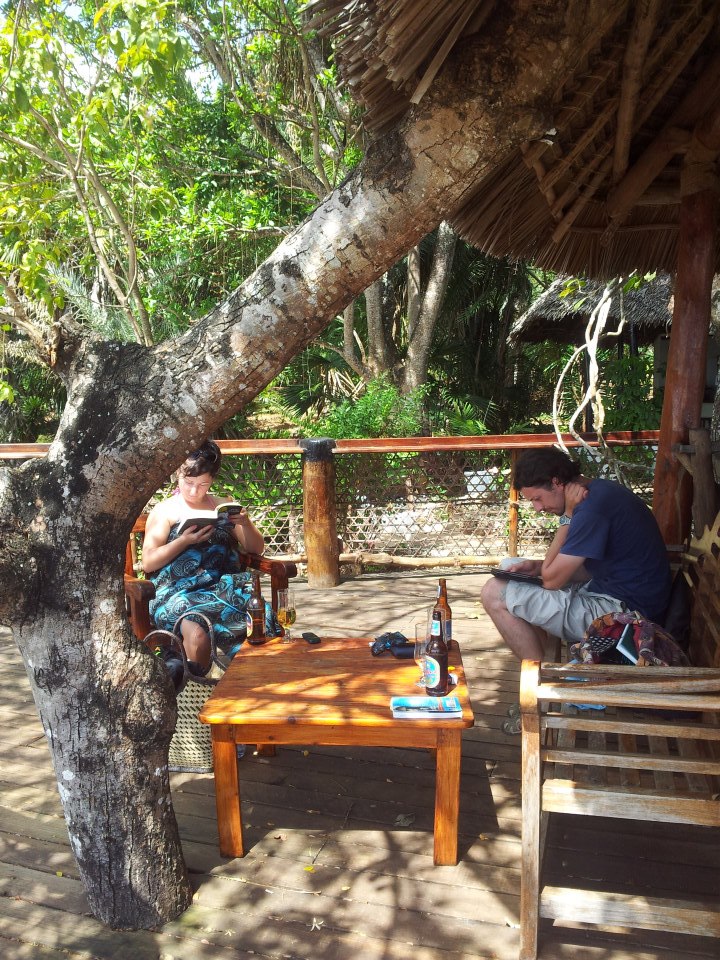
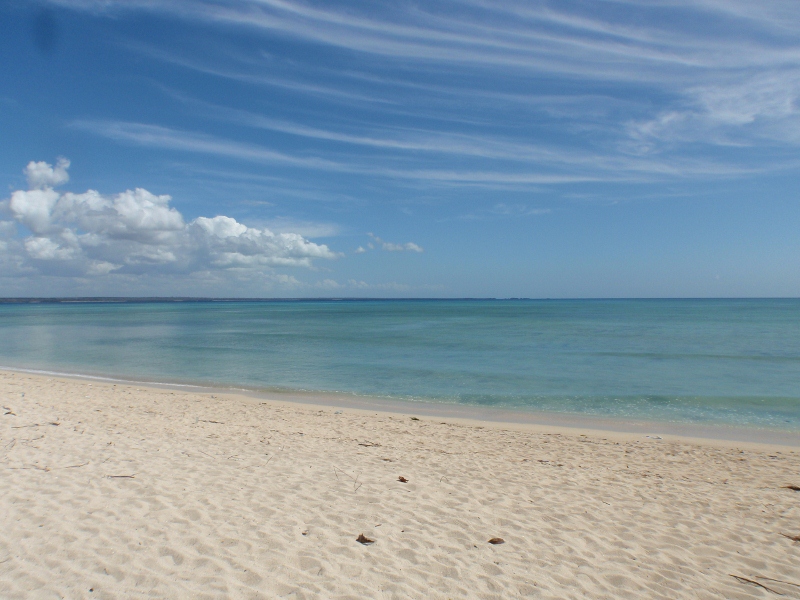
Having a local “in the know” is handy we avoid the tourist traps and head for Mbweni Ruins hotel – set in some lush botanical gardens and with a private beach, mangroves and a pier, perfect for swimming in the warm ocean.  We spend the day relaxing ad sipping on cold Safari Lagers. Handily the pier faces due west, perfect for watching the sunset. Sunsets never get boring, no matter where you are in the world.  We didn’t actually see the ruins - an old chapel and school from the 1800’s, so will have to go back sometime soon (good excuse) !


Mbweni Ruins Hotel

Relaxing, Reading and sipping on a cold beer
Sunset - 'nuff said


The next day we take the daladala (local bus – which was just an old Leyland DAF minibus) to Jozani forest..  The journey takes just over an hour, although we wished it could have lasted longer as the daladala was pumping out old Bob Marley tunes and videos on a small LCD screen gaffa-taped to the ceiling.  Jozari forest is a protected forest, one of the few remaining patches of natural jungle that once covered the island – most has been felled over the centuries for fuel and agricultural land.  It is also home to the native Red Colobus monkeys (Interestingly, being isolated on an island they have evolved to have only 4 fingers on their hands – no thumbs… no other monkeys have this).  The chap at the visitor centre at the conservation project was somewhat surprised we arrived by bus, most mzungus arrive by 4x4 on a package tour and pay an extortionate price for the pleasure.  Our guide led us ten minutes into the forest, and we were amongst a troop of monkeys.  I was amazed at how they were not at all bothered by our presence, and carried on with their monkey business literally within touching distance.  One of the monkeys ran right in front of me (slightly disconcerting as they are pretty big buggers and all muscle!), and another sat on a log next to Kay!  It certainly beats paying a tenner to peer through a greasy glass window at Monkey World! 

Just hanging out

Monkey see Monkey do

Hey Hey, We're the Monkeys

Monkeying Around
Run out of monkey puns

After the monkeys, our guide took us to the nearby Mangrove forest.. Kay on the back of a pikipiki and me on a rickety old pushbike.  I discovered it's quite hard to ride a bike with a flat front tyre and dodgy brakes along a potholed gravel track.   The tidal saltwater mangroves are breeding grounds for many types of fish, and are another endangered habitat on the island as mangrove wood is good building material.  

As easy as riding a bike
Swampy

 
Just 1km down the road is the Jozani butterfly sanctuary – another conservation project which has taught local villagers how to farm and collect the pupae from the fifty or so species of exotic butterflies found in the forest.  The pupae are sold to collectors worldwide which provides income for the villagers and ensures that the forest is protected and the butterfly populations continue to flourish.  Part of the forest has been enclosed in netting, and you are free to walk around with the butterflies – one of them even started eating the sweat off my hand..  yummy !


Pupae Farming
Ever been licked by a Butterfly in the pale moonlight?


It's not a butterfly, it's a praying mantis


After 4 days relaxing in Zanzibar I returned to the hustle and bustle of Dar, and then the long drive back south to Nyangao.  It seems I was missed in Nyangao, as the next time I walked through the market there were many cries of “Mr Jamesy, You back now!”.   Yes Nyangao,  I’m back.. ...And I bought Cheese and Mince with me!   I will buy your tomatoes and make them into spaghetti bolognase, Chilli con carne and Shepard’s pie !  Mzungu in Africa!!!


Monday, 24 September 2012

The Road to Dar es Salaam

Hello Blog!  Been a while.

The thing about living and working in a different country is just that… you live and work…. Once you get used to it, it’s not that exciting, and certainly not exciting enough to blog about!  Today I went to work, understood  few words of kiswahili, did some work, then went home.  Yesterday I went to the market, bought some tomatoes, then went home! 
However now I do have something to write about as I’ve just got back from a short trip to Zanzibar, and writing about that will make you all very jealous ;)

Firstly let me tell you about the road to Dar-es-Salaam..  

There is only one road running north-south along the east coast.  It’s about 450km from Lindi to Dar es salaam.. and to get to Lindi from my village I have to travel East for about 80km, so a total distance of over 500km. (over 300 miles) Which should not be a problem.. just like driving from Bournemouth to say Leeds. –should take less than 5 hours travelling at a reasonable speed on decent roads.    Yes, decent roads.  A thing that Tanzania seems to lack……….

I was travelling in the hospital vehicle, as it was taking some of the hospital staff and Sisters from the convent to a conference in Dar es salaam so I blagged a lift.  I knew it was going to be a long trip when after only 20 minutes of driving out of the village the road was closed for works, and traffic diverted along a dirt track alongside.  A lorry had jack knifed on this dirt track, blocked it completely and was in the process of being dug out by hand.  A traffic jam was forming (2 lorrys and 3 busses) and lots of people were stood watching, including the guys who were supposed to be working on the main road.  Nobody was moving until the lorry was out!

Thankfully I was in the Hospital Toyota Landcruiser.. a beast of a 4x4 with the awesome Mr Erick at the wheel.  He got out, had a little wander up the dirt track, stopped to think then got back in the cab, switched to off road mode, drove up a 40 degree slope, turned along the crest, drove at an angle that had me hanging onto the overhead handgrip for dear life, down the hill beeping his horn to scatter the people stood round the stuck lorry, through a gap between the lorry and a bus that had me breathing in to help us get through, up another bank, knocked a tree down and drove over it, and back on the tarmac the other side of the diversion!  Respect Mr Erick!!   Jealous looking faces from the people stuck on the busses, and on we went!

It’s a tarmac road to Lindi, nice and fast (although you do need to avoid animals/children/people on bicycles carrying animals/children/coconuts/charcoal/wood/other bikes and everything else ), and North from Lindi, the road is good and wide, and is fairly easy to overatake the slow moving lorries, slowing only to pass through the many villages en-route.  Fairly easy going for another 100km.
I'm sure he can fit some more on there


Then the road stops.


                    Just stops.


  It has not been built yet.  – it looks like it has been started.  There is a foundation, some drainage pipes in places, and in two places there are concrete supports for a bridge.  But no bridges. 
Instead, you are forced to drive on a dirt/sand track alongside the “road”, full of bumps and holes and patches of loose sand and lots of dust.  Not many vehicles use the road.  Those that do are either very slow lorries, very hard to overtake on a narrow sandy track; insane 4x4 drivers going fast and kicking up dust; or the trans-country coaches driving at INSANE speed, almost getting airborne on the bumps and creating a dust cloud thicker than that Icelandic volcano nobody could pronounce. 
Trans-country coach.  Mentalists

  
    There’s no 50mph limit with average speed cameras, no contra-flow, no traffic cones, no temporary cat-eyes, no convoy system in place, or any of the luxuries found in UK roadworks.  However like all good roadworks worldwide, there were a few men in flo-jackets standing around or leaning on shovels, and I did see a couple of roller-machines and a tarmac layer, but they were not moving. 

And so it continues, being thrown around the back of a Toyota Landcruiser for about 90 minutes, to cover a distance of about 60km.  Bumps, holes and dust.   At some points I was airborne and flying towards one of the Sisters, other times I thought I may have broken my coccyx after being slammed back onto the not very padded bench seats.   Windows closed because of the dust, so starting to roast in the 30+ degree Tanzanian sunshine.   All the while, Mr Erick smiling like a man possessed!


Then the black at the end of the dust.. tarmac!  What a relief… everyone adjusts themselves, stops hanging on for dear life opens the windows and breathes!
Then it starts again!  This time is more frustrating as there is a complete road, tarmacked and looking lovely just alongside the sandy track.  However it seems the Ministry of Transport were not happy with the quality of the road, and have ordered it to be ripped up and replaced.    Seeing as it has taken the best part of 10 years to not yet finish the road, I do not want to guess how long it will take to rebuild this section. 
 
In the rainy season the track becomes a mud-fest.  It is virtually impassable.  Where the bridge supports are built are where rivers run in the rainy season but there are no bridges built, so you have to ford the rivers!  There are rumours of locals diverting unwary vehicles around a puddle of mud saying it is impassable, towards an even worse mud pool where they get stuck and looted!  Cars, lorries and busses often get stuck in the mire, and block the road for all other traffic.  Chaos!

Once past the bad road it’s all fairly plain sailing until you get to within 40 miles of Dar, and then it’s a traffic jam all the way into the city, another couple of hours to travel not very far! 

Total distance approx. 500km, 300miles.   Total time taken 10 hours.  Number of bruised butt cheeks 2.  Number of minutes taken to drink the first beer upon arrival in Dar es salaam 5.  


Once the road is completed it will open up the whole of southern Tanzania to the rest of the country.  It will enable the southern farmers to reach new markets in the northern cities, enable the efficient transport of people and materials to the newly discovered oil and gas deposits in Mtwara, improve tourism to the southern Game reserves, and generally be huge step towards increasing prosperity and relieving poverty in the area.   So why has it taken 10 years to not finish it? .. This is Tanzania !   

 oh yeah, I was going to tell you about Zanzibar..... well that's another post! 


Sunday, 23 September 2012

It's the little things that keep you happy !

I bought some cheese and mince back from Dar es Salaam... so made a spaghetti bolognase with cheese on top!  You have no idea how happy this makes me !!  AND there is enough left for tomorrow!  Even my Kenyan housemate likes it ;) 

Monday, 13 August 2012

Mtwara


Last weekend I took the 3 hour bus ride to the largest town in the area- Mtwara.   Infact it is the largest town for hundreds of miles!  Myself and two intern doctors who are working at nyangao stayed in a beach house directly on a very pretty beach.  The best thing about Mtwara is it has a bigger market than nyangao as well as many shops selling goodies.  I have spent about two weeks wages on luxuries such as jam, biscuits, nutella, sausages, honey, pineapple, beans, tinned tuna, and best of all.... CHEESE !  (2 days wages for a block of cheddar, but I'm SO looking forward to cheese on toast!). 


Sunday, 12 August 2012

Pictures of the lab


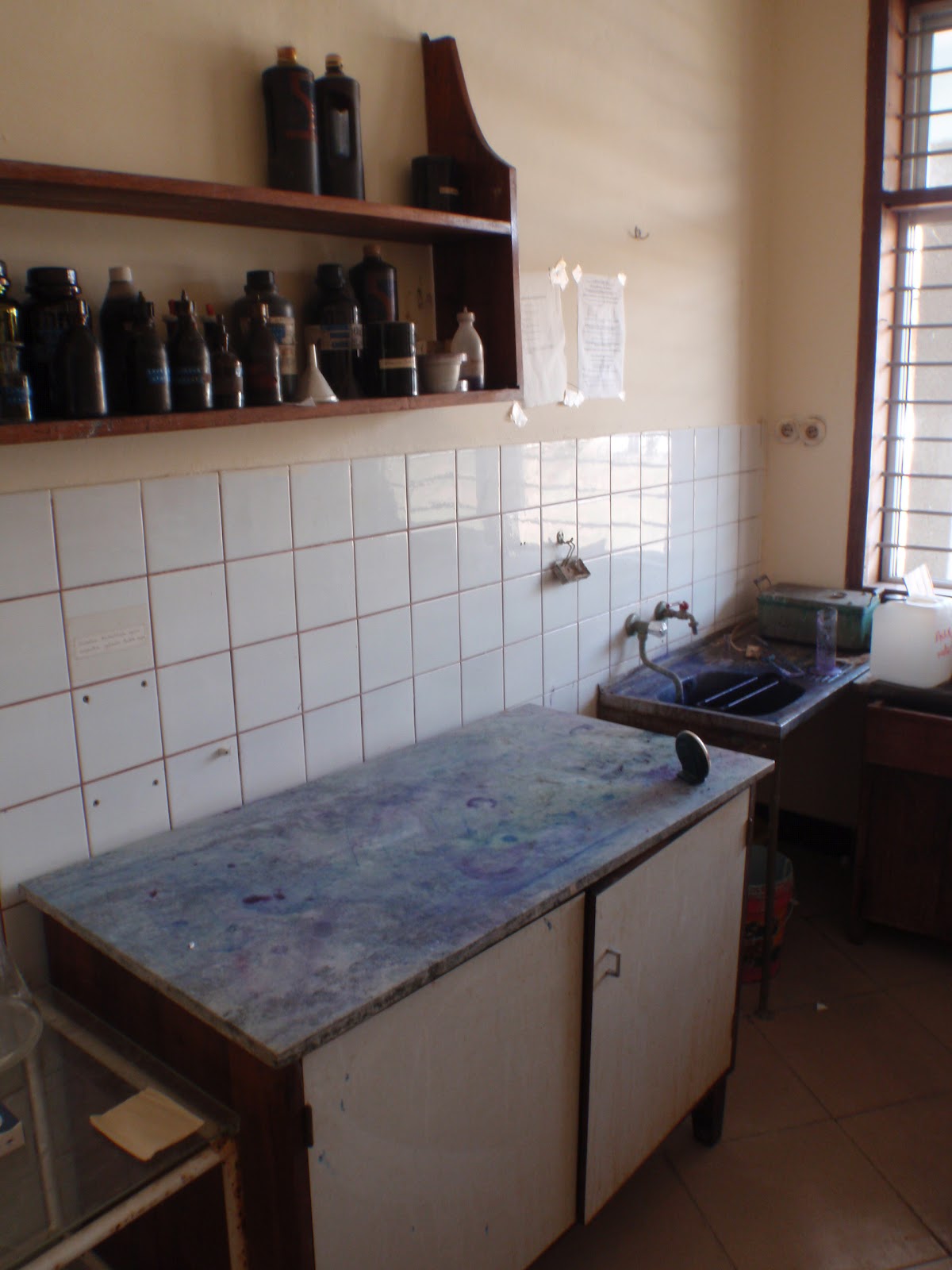
For all those who are geeky enough to be interested, I thought I'd put some pictures of the lab and the equipment that I'm using. 

View of the hospital from my house - as you can see, not far to walk in the mornings!


The work is not too different to that back in the UK- it's a lot quieter here, we see about 100 patients on a very busy day, but usually about 50. – and of course there is no GP work to do!  There is a problem with supply of reagents and consumables and the lab often runs out of vital things (on Friday we ran out of EDTA tubes).    
Phlebotomy area


Request Form
   The main tests are Hb - done using Haemocue (or the Ebra 7 if we have run out of haemocue test strips) and thick film for malaria.  Thin films are not done at all, but that’s something that I wil be working on!   There is an Horiba Micros for FBC - although only approx 5 FBC are done per day - Hb is the most useful parameter, and there is little value in knowing WBC count in patients with known fever as they will be put on antibiotics anyway, or PLT counts when there are no treatments available

Haemocue for Hb
Haematology Analyser

 
ESR

  Microbiology offers urine and stool microscopy for parasites, AFB for TB diagnosis, and culture and sensitivity.  - not my strongest subject by any means, but I'm learning microscopy pretty rapidly!

Microbiology Bench

The Biochemistry area has an ebra 7 (a glorified spectrophotometer) and a new analyser (humastar) both can so basic tests such as glucose, AST, ALT, Creatinine and bilirubin and there is a BD FACS flow cytometer for CD4 monitoring.  
Flow cytometer for CD4
Biochemistry Bench


The old chemistry analyser
The new automated chemistry analyser


 The biggest difference compared to in the UK has to be Blood Bank.  Transfusions are done using Whole blood – not separated components!  We get some units from the blood centre in Mtwara, but the supply of these is patchy at best, so most of the blood we have is collected in the laboratory from the relatives of patients having operations!  Donors are bled by lab staff, and samples are sent to mtwara for donor screening for HIV Hep and Syphilis. 

  The blood bank itself is just a domestic fridge (and used for reagent storage as well!)  - as you can imagine there is no CPA or MHRA in Tanzania, and SR would have a fit if she saw the state of the fridge ;) 
The Blood Bank 
When a patient needs blood, the donor unit and patient are group typed using tile method, (ABO and RhD),  and a Room Temperature compatibility test done (no IAT at 37C)!  I do find this difficult, having being trained to ALWAYS do an IAT, there are very few transfusion reactions (there are very few patients with antibodies… few patients have repeat transfusions, and RhD immunisation is not a problem as 95% of east Africans are Rh(D) Positive).  
Transfusion Area


The Blood Bank!


One of my aims here is to study the use of blood, transfusion triggers, blood safety, etc etc and see if any of the UK system can be applied in here to improve the safety and service of blood bank.   It’s going to be a big project, but that why I’m here for 2 years!


Well, hope this has satisfied all you science geeks!  If you want to know more please get in touch, and I’m sure I will be in touch with a few of my former colleagues to get some advice at some point (SR, VCV/CT and SG – I’m thinking of you!!)


Peas and love x


Wednesday, 8 August 2012