Monday, 24 September 2012

The Road to Dar es Salaam

Hello Blog!  Been a while.

The thing about living and working in a different country is just that… you live and work…. Once you get used to it, it’s not that exciting, and certainly not exciting enough to blog about!  Today I went to work, understood  few words of kiswahili, did some work, then went home.  Yesterday I went to the market, bought some tomatoes, then went home! 
However now I do have something to write about as I’ve just got back from a short trip to Zanzibar, and writing about that will make you all very jealous ;)

Firstly let me tell you about the road to Dar-es-Salaam..  

There is only one road running north-south along the east coast.  It’s about 450km from Lindi to Dar es salaam.. and to get to Lindi from my village I have to travel East for about 80km, so a total distance of over 500km. (over 300 miles) Which should not be a problem.. just like driving from Bournemouth to say Leeds. –should take less than 5 hours travelling at a reasonable speed on decent roads.    Yes, decent roads.  A thing that Tanzania seems to lack……….

I was travelling in the hospital vehicle, as it was taking some of the hospital staff and Sisters from the convent to a conference in Dar es salaam so I blagged a lift.  I knew it was going to be a long trip when after only 20 minutes of driving out of the village the road was closed for works, and traffic diverted along a dirt track alongside.  A lorry had jack knifed on this dirt track, blocked it completely and was in the process of being dug out by hand.  A traffic jam was forming (2 lorrys and 3 busses) and lots of people were stood watching, including the guys who were supposed to be working on the main road.  Nobody was moving until the lorry was out!

Thankfully I was in the Hospital Toyota Landcruiser.. a beast of a 4x4 with the awesome Mr Erick at the wheel.  He got out, had a little wander up the dirt track, stopped to think then got back in the cab, switched to off road mode, drove up a 40 degree slope, turned along the crest, drove at an angle that had me hanging onto the overhead handgrip for dear life, down the hill beeping his horn to scatter the people stood round the stuck lorry, through a gap between the lorry and a bus that had me breathing in to help us get through, up another bank, knocked a tree down and drove over it, and back on the tarmac the other side of the diversion!  Respect Mr Erick!!   Jealous looking faces from the people stuck on the busses, and on we went!

It’s a tarmac road to Lindi, nice and fast (although you do need to avoid animals/children/people on bicycles carrying animals/children/coconuts/charcoal/wood/other bikes and everything else ), and North from Lindi, the road is good and wide, and is fairly easy to overatake the slow moving lorries, slowing only to pass through the many villages en-route.  Fairly easy going for another 100km.
I'm sure he can fit some more on there


Then the road stops.


                    Just stops.


  It has not been built yet.  – it looks like it has been started.  There is a foundation, some drainage pipes in places, and in two places there are concrete supports for a bridge.  But no bridges. 
Instead, you are forced to drive on a dirt/sand track alongside the “road”, full of bumps and holes and patches of loose sand and lots of dust.  Not many vehicles use the road.  Those that do are either very slow lorries, very hard to overtake on a narrow sandy track; insane 4x4 drivers going fast and kicking up dust; or the trans-country coaches driving at INSANE speed, almost getting airborne on the bumps and creating a dust cloud thicker than that Icelandic volcano nobody could pronounce. 
Trans-country coach.  Mentalists

  
    There’s no 50mph limit with average speed cameras, no contra-flow, no traffic cones, no temporary cat-eyes, no convoy system in place, or any of the luxuries found in UK roadworks.  However like all good roadworks worldwide, there were a few men in flo-jackets standing around or leaning on shovels, and I did see a couple of roller-machines and a tarmac layer, but they were not moving. 

And so it continues, being thrown around the back of a Toyota Landcruiser for about 90 minutes, to cover a distance of about 60km.  Bumps, holes and dust.   At some points I was airborne and flying towards one of the Sisters, other times I thought I may have broken my coccyx after being slammed back onto the not very padded bench seats.   Windows closed because of the dust, so starting to roast in the 30+ degree Tanzanian sunshine.   All the while, Mr Erick smiling like a man possessed!


Then the black at the end of the dust.. tarmac!  What a relief… everyone adjusts themselves, stops hanging on for dear life opens the windows and breathes!
Then it starts again!  This time is more frustrating as there is a complete road, tarmacked and looking lovely just alongside the sandy track.  However it seems the Ministry of Transport were not happy with the quality of the road, and have ordered it to be ripped up and replaced.    Seeing as it has taken the best part of 10 years to not yet finish the road, I do not want to guess how long it will take to rebuild this section. 
 
In the rainy season the track becomes a mud-fest.  It is virtually impassable.  Where the bridge supports are built are where rivers run in the rainy season but there are no bridges built, so you have to ford the rivers!  There are rumours of locals diverting unwary vehicles around a puddle of mud saying it is impassable, towards an even worse mud pool where they get stuck and looted!  Cars, lorries and busses often get stuck in the mire, and block the road for all other traffic.  Chaos!

Once past the bad road it’s all fairly plain sailing until you get to within 40 miles of Dar, and then it’s a traffic jam all the way into the city, another couple of hours to travel not very far! 

Total distance approx. 500km, 300miles.   Total time taken 10 hours.  Number of bruised butt cheeks 2.  Number of minutes taken to drink the first beer upon arrival in Dar es salaam 5.  


Once the road is completed it will open up the whole of southern Tanzania to the rest of the country.  It will enable the southern farmers to reach new markets in the northern cities, enable the efficient transport of people and materials to the newly discovered oil and gas deposits in Mtwara, improve tourism to the southern Game reserves, and generally be huge step towards increasing prosperity and relieving poverty in the area.   So why has it taken 10 years to not finish it? .. This is Tanzania !   

 oh yeah, I was going to tell you about Zanzibar..... well that's another post! 


Sunday, 23 September 2012

It's the little things that keep you happy !

I bought some cheese and mince back from Dar es Salaam... so made a spaghetti bolognase with cheese on top!  You have no idea how happy this makes me !!  AND there is enough left for tomorrow!  Even my Kenyan housemate likes it ;) 

Monday, 13 August 2012

Mtwara


Last weekend I took the 3 hour bus ride to the largest town in the area- Mtwara.   Infact it is the largest town for hundreds of miles!  Myself and two intern doctors who are working at nyangao stayed in a beach house directly on a very pretty beach.  The best thing about Mtwara is it has a bigger market than nyangao as well as many shops selling goodies.  I have spent about two weeks wages on luxuries such as jam, biscuits, nutella, sausages, honey, pineapple, beans, tinned tuna, and best of all.... CHEESE !  (2 days wages for a block of cheddar, but I'm SO looking forward to cheese on toast!). 


Sunday, 12 August 2012

Pictures of the lab


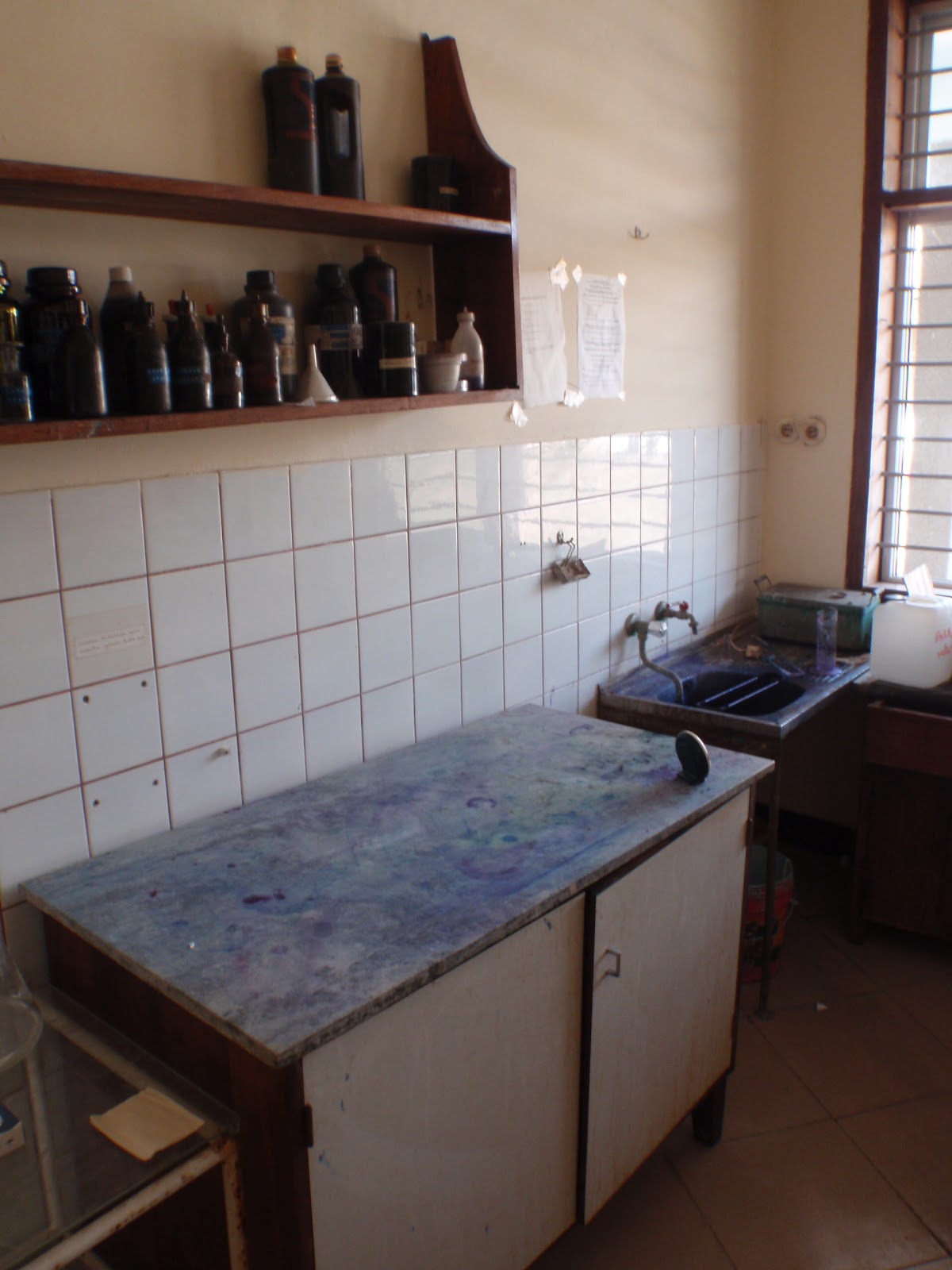
For all those who are geeky enough to be interested, I thought I'd put some pictures of the lab and the equipment that I'm using. 

View of the hospital from my house - as you can see, not far to walk in the mornings!


The work is not too different to that back in the UK- it's a lot quieter here, we see about 100 patients on a very busy day, but usually about 50. – and of course there is no GP work to do!  There is a problem with supply of reagents and consumables and the lab often runs out of vital things (on Friday we ran out of EDTA tubes).    
Phlebotomy area


Request Form
   The main tests are Hb - done using Haemocue (or the Ebra 7 if we have run out of haemocue test strips) and thick film for malaria.  Thin films are not done at all, but that’s something that I wil be working on!   There is an Horiba Micros for FBC - although only approx 5 FBC are done per day - Hb is the most useful parameter, and there is little value in knowing WBC count in patients with known fever as they will be put on antibiotics anyway, or PLT counts when there are no treatments available

Haemocue for Hb
Haematology Analyser

 
ESR

  Microbiology offers urine and stool microscopy for parasites, AFB for TB diagnosis, and culture and sensitivity.  - not my strongest subject by any means, but I'm learning microscopy pretty rapidly!

Microbiology Bench

The Biochemistry area has an ebra 7 (a glorified spectrophotometer) and a new analyser (humastar) both can so basic tests such as glucose, AST, ALT, Creatinine and bilirubin and there is a BD FACS flow cytometer for CD4 monitoring.  
Flow cytometer for CD4
Biochemistry Bench


The old chemistry analyser
The new automated chemistry analyser


 The biggest difference compared to in the UK has to be Blood Bank.  Transfusions are done using Whole blood – not separated components!  We get some units from the blood centre in Mtwara, but the supply of these is patchy at best, so most of the blood we have is collected in the laboratory from the relatives of patients having operations!  Donors are bled by lab staff, and samples are sent to mtwara for donor screening for HIV Hep and Syphilis. 

  The blood bank itself is just a domestic fridge (and used for reagent storage as well!)  - as you can imagine there is no CPA or MHRA in Tanzania, and SR would have a fit if she saw the state of the fridge ;) 
The Blood Bank 
When a patient needs blood, the donor unit and patient are group typed using tile method, (ABO and RhD),  and a Room Temperature compatibility test done (no IAT at 37C)!  I do find this difficult, having being trained to ALWAYS do an IAT, there are very few transfusion reactions (there are very few patients with antibodies… few patients have repeat transfusions, and RhD immunisation is not a problem as 95% of east Africans are Rh(D) Positive).  
Transfusion Area


The Blood Bank!


One of my aims here is to study the use of blood, transfusion triggers, blood safety, etc etc and see if any of the UK system can be applied in here to improve the safety and service of blood bank.   It’s going to be a big project, but that why I’m here for 2 years!


Well, hope this has satisfied all you science geeks!  If you want to know more please get in touch, and I’m sure I will be in touch with a few of my former colleagues to get some advice at some point (SR, VCV/CT and SG – I’m thinking of you!!)


Peas and love x


Wednesday, 8 August 2012

Monday, 30 July 2012

2 weeks in Nyangao


2 weeks at nyangao and the joy of Shikamoo

Wow, that has gone quickly!  I’m settling in now.. to be honest it was a culture shock at first.  The village is small, with just the hospital, a church a small market and a mosque – so not much to do in the evenings unless I want to become religious!  I am the only mzungu in the village so it seems everyone knows my name and everything I do… “Ahh, Mr James, I saw you in the market yesterday”, “Mr Jamesi, habari za tembea?”  (how was your walk?) …but that does make me something of a local celebrity, and everyone will say hello. 
The language barrier has been a bit of a problem. I speak very very basic Kiswahili and only Some people here speak basic broken English, so I am having to learn quickly!  I’ve already improved in the short time I’ve been here, and  I am meeting with a teacher from the local primary school to arrange lessons.

Having said that, everyone has been very friendly, welcoming and accommodating.  Tanzanians are generally friendly people, as demonstrated by their greetings.  Greetings are an important part of Tanzanian culture, when greeting an elder one must use “Shikamoo” to which the elder will reply “Marahaba”… then there are various levels of formality from “Hujambo” (formal)  to “mambo”- slang <what’s up/any issues?>  to which can be replied “poa” – <cool>.  Once you have said hello as above, then you MUST ask “habari” which means what is the news/how is……  ?.... and not just one “habari”.. oh no. that would be rude…. You should ask habari za asabuhi (news of the morning), habari za familia (news of the family), habari za mama (news of your mother), habari za kazi (news of work), habari za kaka (news of your brother) habari za kuku (news of your chickens), habari za weekend (news of the weekend)
So greetings take a while.. and it is quite rude to skip them and get straight down to business, even at the market or in a shop when all you want is two onions!  What is quite nice is being “Shikamoo’d”.. makes you feel respected.  And I’m actually starting to get offended if kids don’t shikamoo me !

The staff in the laboratory are very friendly, and are used to having volunteers so are very welcoming.  They are grateful that I have come to Tanzania and we all hope we will learn a lot from each other.  They are all helping me with my Kiswahili, and I am helping them with their English.  (For those geeky enough to want to know about the lab, I’ll post some pics and stats soon!).  It is nice living 2 minutes walk from work, although as I entered the hospital gates on Wednesday last week there was a cobra lying in the grass.  I only avoided it as the security guard was telling people to!.. I’m just not used to looking out for lethal animals on my way to work!
A not-so-lethal gecko on my lounge wall !

Saturday, 28 July 2012

Arriving at Nyangao


Well It’s been a couple of weeks since I last updated the blog……Where to begin?  Maybe at the beginning?

So I arrive at Mtwara airport after a short 1 hour flight from Dar es Salaam, and what a spectacular flight with views of the Tanzanian coastline, the Indian ocean and Mafia Island.  Remember when Hurn airport was just a shed in a field with a bit of tarmac.. well that’s Mtwara airport. After being ushered off the plane and into “terminal one” (there is only one!) , a couple of blokes unloaded the luggage from the plane onto a glorified wheelbarrow and pushed it into the building, and unloaded the bags onto a table in the room where myself and the other  passengers where waiting.  Then everyone went home – only one flight a day it seems!  

Thankfully I was met at the airport by the Hospital driver – a chap named Eric.  That’s all I got from him as I can’t speak Swahili and he can’t speak English!  Instead of going straight to the hospital we went to the MSD (medical stores department) in Mtwara apparently to pick up some items for the hospital.  So we waited, and waited and waited.  I tried to find out what was going on in my (very) basic Swahili, and think I got told that we were waiting.  By this time I gathered that we were waiting, so waited some more.  After waiting for two hours, we waited some more.  Then a truck came and unloaded some boxes.. that was exciting, and after that we waited….I think we waited for a bit more, and finally after 3 hours of waiting we apparently got what we came for – 2 small boxes of something!  So off we went!  (I’ve since learnt that pone of my jobs will be going to MSD to pick up supplies for the lab.. note to self: take a book)
The drive from Mtwara to Nyangao takes around 2 ½ hours  on the only tarmac road in the region!  The road passes through plantations of coconut, mango, rice, banana and tomatoes and oranges, and  cuts through many small villages consisting of a few mud huts, some street vendors selling tomatoes and oranges.   I was admiring the sun setting over the hills in the distance as we drove through another village when we suddenly turned off the tarmac onto a dirt track for a few hundred metres and passed a sign saying NYANGAO HOSPITAL.   I had arrived!   When VSO said I was in a rural location, they were not bloody joking


In at the deep end
After arriving at my new house and meeting my housemate – Evelyn – a VSO volunteer from Kenya who has been at Nyangao for about 6 months we went to the bar in the village (the only bar).. when I say Bar, what I mean is a shack with some patio tables and chairs and a roof made from coconut palm fronds – but it does sell beer (and is called Old Trafford)!- to meet Ronnie – the hospital administrator, from Uganda, and a previous VSO volunteer.   A quick cola and a chipsi-mayai later* I was in bed spending my first night in my new house and ready to start work the next day.
The next morning at 7.30 I was thrust into the daily clinical meeting with all of the doctors at the hospital, met the chief doctor and chief surgeon then was shown around the hospital meeting every single one of the 300ish staff…  I’m now called Mr Jamesi – and everyone knows my name even if I have no idea about theirs! 

                                      (Photo taken from Google Images)

* chipsi-mayai  (chips and eggs) is probably Tanzania's second national dish (after ugali).. and is basically a Chip Omlette !  Cooked in a pan over a charcol burner and sold on every street corner and every tiny village it is greasy, tasty and generally cheap and contains none of your 5 a day! It is usually eaten using a cocktail stick -  Good nosh - try it! 
chipsi mayai ..   just needs lashings of chili sauce